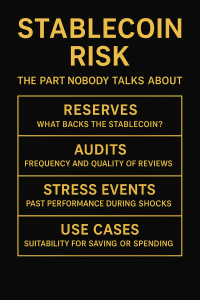
Stablecoin Risk – Stablecoins are often viewed as the safe corner of crypto. They are the digital dollars we hold for stability. They are used when we want low volatility and peace of mind.
But here’s the uncomfortable truth:
Stablecoins carry risks nobody talks about.
Not because they’re unsafe…
But because most people don’t understand how they work.
If you hold USDT, USDC, FDUSD, DAI, PYUSD, TUSD (or even AED-stable digital dirhams someday), this guide is for you.
Table of Contents
Stablecoin Risk – Why We Don’t Talk About Stablecoin Risk Enough
Stablecoins feel simple:
- 1 USDT = $1
- 1 USDC = $1
- You can send them instantly
- Fees are low
- They “just work”
This false sense of security makes people skip the research.
But when you peel back the layers, stablecoin safety depends on:
- Who issues it
- How it’s backed
- Where it’s stored
- Which chain do you use it on
- How it’s bridged across networks
- How regulators treat it
Let’s break down the hidden risks one by one. – StableCoin Risk

1. Issuer & Reserve Risk: The Foundation Everyone Assumes Is Strong
This is the biggest and most ignored risk.
Every centralised stablecoin (USDT, USDC, PYUSD) depends on trust in the issuer.
Ask yourself:
- Where are the reserves held?
- Are they audited monthly or quarterly?
- Are they in cash, T-Bills, commercial paper, loans, or something else?
- Are they in one bank or many?
- What happens if a bank partner freezes accounts?
Example from history:
2023 USDC De-Peg (0.87 cents)
Circle had part of its reserves stuck in Silicon Valley Bank when it collapsed.
USDC temporarily fell to $0.87, even though it was “fully backed”.
The lesson:
Your stablecoin is only as strong as the financial institutions behind it.
Read More Crypto Safety 2025 Guide – Proven Checks to Avoid Scams (Web3 & Wallets)
2. De-Peg & Liquidity Risk: It Can Lose Its $1 Value
Stablecoins can move off their peg due to:
- Panic withdrawals
- Exchange liquidity issues
- Banking disruptions
- Black swan events
- Market volatility
- Smart contract exploits (for on-chain stablecoins)
Even a temporary drop matters if:
- You need to exit quickly
- You’re trading with high leverage
- You’re receiving payments in it
- You’re staking or LPing with stablecoins
Real-world example:
TerraUST Collapse (2022)
UST was marketed as “the most stable stablecoin”.
It went from $1 → $0.01.
That event alone proved:
“Stable” doesn’t always mean stable.
Read More Crypto Guide UAE 2025 – Beginner’s Playbook for Safe Investing
3. Chain Risk: Not All Stablecoins Are Equal Everywhere – Stablecoin Risk
Most people don’t know this:
Many stablecoins you see on different chains are NOT minted by the issuer; they’re wrapped versions.
For example:
- USDT on Tron = native
- USDT on Ethereum = native
- USDT on Arbitrum = bridged copy
- USDT on Polygon = bridged copy
- USDT on Avalanche = bridged copy
If the bridge smart contract gets hacked, funds on that specific chain can become worthless even if the original stablecoin is safe.
This is the most underrated risk in the entire stablecoin space.
4. Bridge Risk: When the Copy Is Not the Original
Bridges are one of the most attacked parts of Web3.
Over $2.8 billion has been stolen from bridges since 2021.
If a bridge that holds the original asset reserves gets hacked:
- The wrapped stablecoin de-pegs
- Liquidity dries up
- Exchanges halt trading
- Your “$1” token might suddenly be worth $0.10 or less
Examples:
- Wormhole bridge hack
- Horizon bridge exploit
- Ronin bridge exploit
- Multichain collapse
If you use stablecoins across chains, you must understand this risk.
Read More Privacy Coins-The Positive Future (2025 Surge Explained)
5. Regulatory & Legal Risk: Policies Shift Overnight – Stablecoin Risk
Stablecoin laws are evolving very fast:
United States
Discussing federal stablecoin rules—issuer licensing, reserve audits, and consumer protection.
Europe (MiCA)
Strict requirements for:
- reserve transparency
- segregation of funds
- issuer licensing
- quarterly reporting
- redemption guarantees
UAE / Dubai (VARA)
Focusing on:
- licensed stablecoin issuers
- clear backing
- compliance with FATF standards
- risk monitoring
- exchange oversight
This matters because one regulation can:
- freeze assets
- restrict usage
- force exchanges to delist a stablecoin
- Impact liquidity in your region
Regulatory risk is not theoretical; it’s real.
6. Smart Contract & Protocol Risk (For Decentralised Stablecoins)
Stablecoins like DAI, FRAX, GHO, and crvUSD rely on:
- Ethereum smart contracts
- Overcollateralization
- Liquidation engines
- Oracle feeds
- Automated supply adjustments
Risks include:
- Oracle failure
- Liquidation spirals
- Collateral volatility
- Liquidity drying up
- Governance attacks
These are rare but possible.
And when something breaks in DeFi, it breaks fast.
Read More DeFi (decentralized Finance) Without the Buzzwords: AMMs & Liquidity Pools(2025)
7. Use-Case Risk: When We Trust Stablecoins More Than We Should
Some people mistakenly use stablecoins for:
- long-term savings (should not do this)
- payroll for remote teams
- business reserves
- high APY farming
- emergency funds
Stablecoins are NOT a replacement for a bank account.
They’re perfect for:
- fast payments
- trading
- hedging
- cross-border transfers
- temporary capital storage
- DeFi liquidity strategies
Not ideal for:
- storing your life savings
- long-term wealth
- retirement planning
Stablecoin Risk – Key Risks of Stablecoins
- Market Risks: Stablecoins can experience depeg events, where their value diverges from the asset they are pegged to, often due to market volatility or loss of confidence. This can lead to significant financial losses for users who rely on their stability. 1
- Regulatory Risks: The regulatory landscape for stablecoins is still evolving, with different jurisdictions adopting varying approaches. This creates legal uncertainties for issuers and users, potentially leading to compliance challenges and operational disruptions. 1
- Centralization Risks: Many stablecoins are issued by centralized entities, which can introduce risks such as single points of failure. Centralized issuers have the authority to freeze accounts or alter the supply of stablecoins, which can undermine user autonomy and trust. 1
- Transparency and Trust Issues: Users must trust that stablecoin issuers maintain adequate reserves to back their tokens. Past controversies over reserve audits have raised concerns about the transparency of these reserves, leading to skepticism about the actual stability of the stablecoins. 2
- Technical Vulnerabilities: Stablecoins are subject to the same technical risks as other blockchain-based assets, including smart contract bugs, oracle failures, and scalability issues. These vulnerabilities can lead to theft, loss of funds, or disruptions in the stablecoin’s peg. 1
- Contagion Risks: The interconnectedness of stablecoins with traditional financial systems means that a failure of a major stablecoin could have widespread implications, potentially leading to liquidity crises in crypto-asset markets and beyond. 1
- Economic Implications: The growth of stablecoins could disrupt traditional banking systems, as funds may flow out of bank deposits into stablecoin reserves, affecting banks’ ability to create credit and manage liquidity. 1
Stablecoin Risk – How to Stay Safe: Stablecoin Protection Checklist (2025)
✔ Use two stablecoins, not one
Split between USDT + USDC or USDC + PYUSD.
✔ Prefer native chain versions
Avoid wrapped or bridged versions.
✔ Avoid unknown stablecoins
No small-cap “new stablecoin projects”.
✔ Keep stablecoins in self-custody when possible
On-chain > exchanges (for long holds).
✔ For businesses: choose regulated stablecoins
Especially in the UAE, EU, and US-regulated environments.
✔ Diversify your chains
Don’t keep everything on one chain (Tron outages happen, too).
✔ Watch regulatory announcements
They impact liquidity.
| Key Takeaways |
|---|
|
• Understand who issues your stablecoin and how the reserves are managed. • Always check whether you’re holding a native stablecoin or a bridged version — bridge failures can wipe out value. • De-pegs can happen during market stress; always monitor liquidity and redemption guarantees. • Regulatory announcements can directly impact stablecoin stability and usage. • The safest approach is diversifying, avoiding long-term storage, and sticking to reputable stablecoins. |
⭐ Conclusion – Stablecoin Risk
Stablecoins are one of the most powerful innovations in Web3:
- Fast
- Borderless
- Easy to use
- Perfect for payments
- Critical for traders
- Essential for DeFi
But they carry hidden risks that most users aren’t aware of.
Understanding these risks doesn’t make stablecoins less useful.
It makes YOU more powerful, more informed, and far safer in the ecosystem.
If you want to understand why stablecoins matter, and how they fit into the future of crypto, read your main article:
👉 Stablecoins: Why They Are Crucial for Crypto
Stablecoins-The Powerful Foundation of Digital Finance(2025)
FAQs – Stablecoin Risk
Are stablecoins 100% safe?
No. Stablecoins are designed to be more stable than regular crypto, but they are not completely risk-free. Their safety depends on the issuer, the quality of reserves, the chain they’re on, and how they are used. They reduce price volatility, but introduce other risks like de-pegging, regulation changes, or bridge failures.
Can a stablecoin really lose its 1:1 peg to the dollar?
Yes. A stablecoin can temporarily or permanently lose its peg due to:
panic selling or market fear
problems with the issuer or reserves
banking or liquidity issues
smart contract or bridge exploits
Sometimes the peg recovers (like USDC in 2023), and sometimes it doesn’t (like UST in 2022).
What’s the difference between a “native” stablecoin and a “bridged” one?
A native stablecoin is issued directly on a specific chain by the official issuer (for example, USDC on Ethereum).
A bridged stablecoin is a copy of that token on another chain, created by locking the original and minting a wrapped version.
If the bridge is hacked or fails, the bridged version can lose value even if the original stablecoin is fine. That’s why native versions are usually safer for larger amounts.
Is it safe to keep my savings in stablecoins long-term?
Stablecoins are great for trading, payments, and short-term parking, but they are not ideal for long-term savings. Over long periods, you’re exposed to:
issuer risk
regulatory changes
technical issues (bridges, smart contracts)
black swan events
For long-term wealth, it’s better to combine stablecoins with more traditional options (like bank deposits or regulated assets), depending on your personal situation.
How can I reduce my risk when using stablecoins?
You can lower your risk by:
using well-known, regulated issuers
avoiding small or experimental stablecoins
preferring native chain versions instead of bridged copies
diversifying between 2 different stablecoins, not just one
keeping only what you need in stablecoins and not your entire net worth
Most importantly, regularly review where your stablecoins are held and stay updated on news about your chosen tokens.